THE EXPERIENCE-LED HOSPITALITY PLAYBOOK
Article 01
What Is Competitive Socialising?
Competitive socialising is not simply a game placed inside a bar. It is a hospitality experience organised around shared participation, social connection and a reason to spend meaningful time together.
By Ales Kernjak, AK Works · 9 min read
Co-written with Zachary Pulman, Zachary Pulman Design Studio

The modern pub game reborn: shared activity, hospitality and social connection designed as one experience. Photo: flightclubdarts.com
From Pub Game to Main Event
It usually starts with something familiar: a dartboard, a bowling lane, a karaoke microphone, a shuffleboard table or a miniature-golf course.
The activity matters, but it is not the whole proposition. Competitive socialising emerges when shared play is deliberately combined with food, drink, hosting, atmosphere and a clear social occasion.
In simple terms, competitive socialising is a form of experience-led hospitality in which shared activity gives people something to do together, while hospitality, service, environment and social interaction shape the wider occasion. The game provides structure. The wider experience determines how easily people join, how long they remain engaged and whether the venue becomes somewhere they choose again.
In the United States, many of these formats sit within the wider category of location-based entertainment, or LBE. That label describes out-of-home experiences organised around a physical destination. Competitive socialising is more specific: it places shared participation at the centre of a hospitality occasion.
The distinction matters because the market has moved beyond novelty. KAM reported in 2025 that nearly three in ten UK adults had visited a dedicated competitive-socialising venue during the previous year. Among visitors, 41 per cent were going at least monthly, up from 35 per cent in 2023 [1].
The category has also become more established. Savills reported in March 2026 that the UK market had grown to more than 800 sites. Its analysis also warned that quality of experience is becoming increasingly important as the market matures and consumers become more selective [2].
That is the central shift. The question is no longer whether people will try an activity-led venue. The question is why they would choose one experience over another, and why they would return once the novelty has passed.
Competitive socialising is not defined by the game. It is defined by what the game allows people to do together.
A Familiar Instinct, Reframed
The instinct to gather around play is not new. Darts and pub quizzes have long shaped social life in Britain [5]. Bowling became a familiar group ritual in the United States. Karaoke remains deeply embedded in social occasions across East Asia. Different formats, different cultures, the same underlying behaviour: play gives a group a shared focus.
What has changed is the role of the activity. Historically, a game often sat at the edge of the occasion. Today, the strongest concepts make it the organising device around which the social experience is built.
Technology may simplify scoring or create visual feedback. Hosts may guide the group through the first moments. Food and drink can arrive around the activity rather than interrupting it. Seating, sightlines and sound can help players and non-players remain part of the same social scene.
Flight Club, for example, uses automatic scoring and simple multiplayer formats so guests can participate without mastering traditional darts scoring [3]. The useful innovation is not that darts becomes more digital. It is that friction is removed from the social experience.
The game is familiar. The conditions around it have changed.
To play. To connect. To belong.
What Competitive Socialising Really Is
Competitive socialising works as a connected experience. Five elements need to support one another:
Play provides the shared activity and a visible sense of progress.
Hospitality gives the group comfort, food, drink and reasons to extend the occasion.
Social energy comes from conversation, competition, spectating and celebration.
Environment shapes confidence, movement and the atmosphere around participation.
Service rhythm connects arrival, onboarding, play, ordering, transitions and departure.
A strong game cannot compensate indefinitely for weak hospitality. A polished room cannot rescue confusing onboarding. Excellent food will not create loyalty if the group feels fragmented or the experience ends abruptly when the activity stops.
The value comes from alignment. Guests may never describe the system, but they feel whether it holds together.
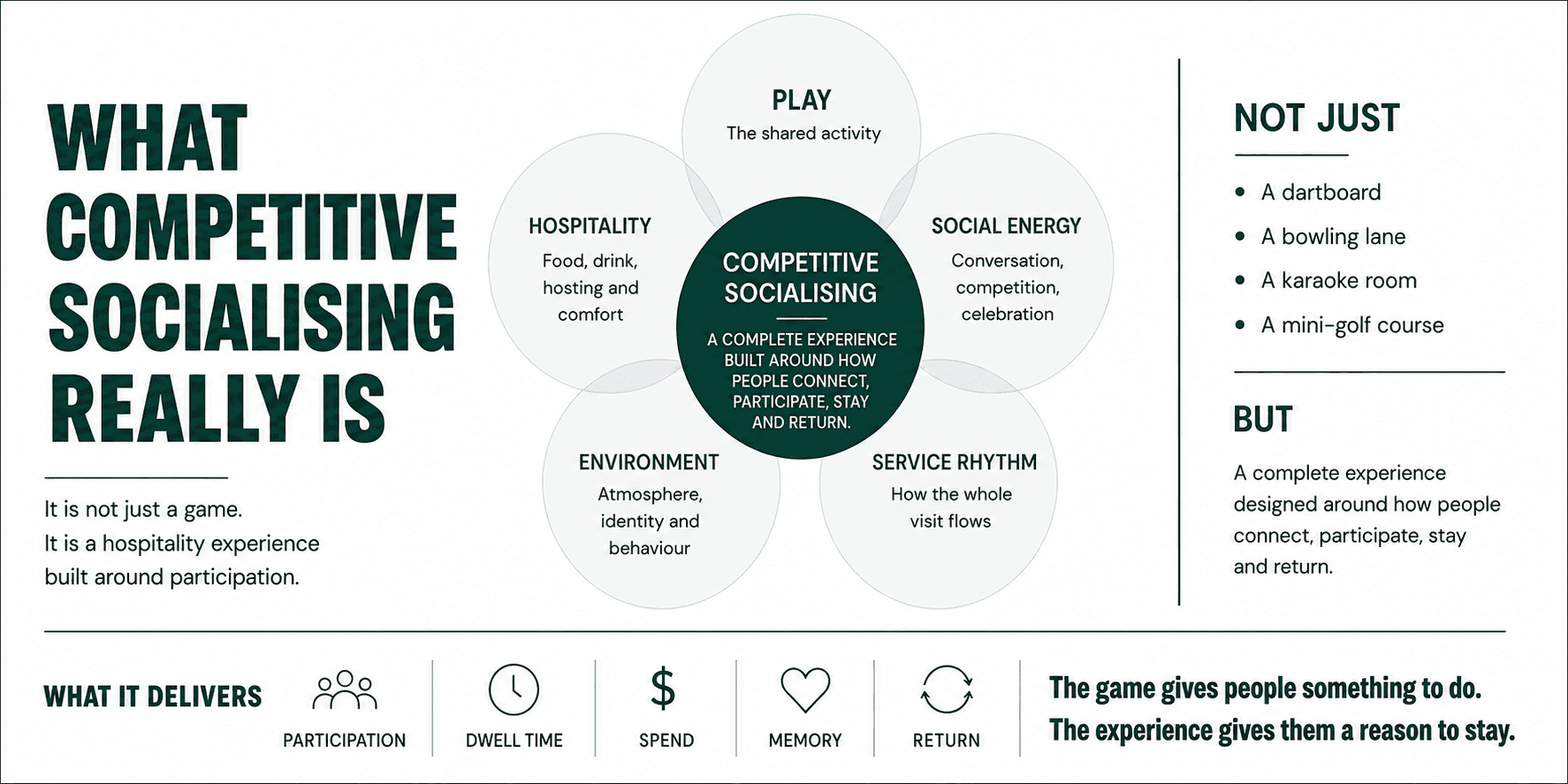
Competitive socialising works when play, hospitality, social energy, environment and service rhythm operate as one experience.
The Group Is Not One Audience
Competitive socialising is usually experienced by groups, but a group is not a single audience. Different people perform different roles within the same visit.
The organiser chooses the venue, manages the booking and carries the reputational risk of the decision. The active player drives competition and visible energy. The spectator participates through watching, reacting and supporting. The social or bar-first guest may care more about atmosphere, conversation and food and drink than the game itself. A regular returns because the experience feels dependable and easy.
These roles can overlap and shift during the visit. The organiser may become the most competitive player. A spectator may join after watching the first round. A player may finish the game and move into a longer social occasion.
This is why inclusive experience design does not mean reducing the competitive element. It means creating multiple legitimate ways to take part.
The venue should make the active player feel engaged without making everyone else feel secondary. Sightlines, seating, hosting, food and drink, game pacing and transitions all influence whether the whole group remains connected.
Not everyone needs to play. Everyone needs to feel part of what is happening.
Why Participation Changes the Experience
Traditional hospitality often asks guests to generate the social energy themselves. They arrive, order and begin a conversation. When the group dynamic is strong, the evening works. When it is not, the venue has limited ability to help.
Competitive socialising adds a framework. The activity gives people a reason to interact without requiring constant conversation. It creates turns, reactions, small victories, friendly disagreements and shared stories.
That lowers social friction. It is useful for established friends, but also for dates, mixed friendship groups, family occasions, new colleagues and corporate teams. The activity gives the group a script without making the experience feel scripted.
Participation also changes how time is perceived. A ninety-minute visit built around several active and social moments can feel fuller than the same amount of passive waiting. This distinction matters. Dwell time is not automatically valuable.
Meaningful dwell time is time people choose to spend because the experience continues to reward their attention.
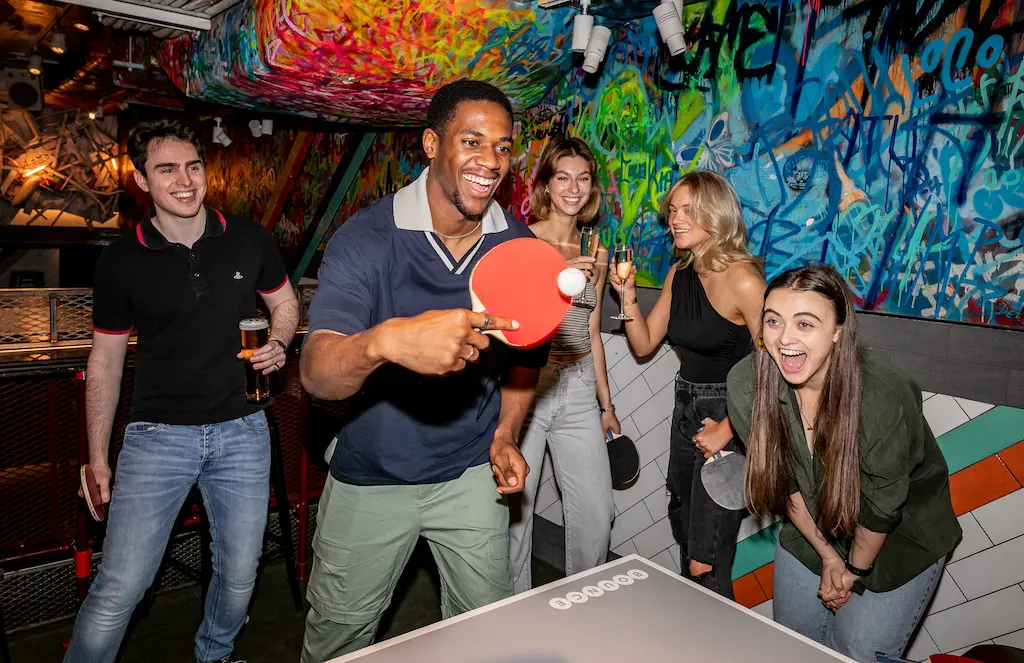
The wider occasion matters as much as the active game. Participation can include watching, reacting, eating, talking and celebrating. Photo: bouncepingpong.com
From Participation to Commercial Value
The commercial case does not begin and end with charging for the game. The activity changes behaviour across the whole visit.
Participation creates social energy. Social energy helps the group remain engaged. Engagement creates opportunities for food, drink, additional rounds, private hire and repeat occasions. A memorable experience then gives the group a reason to return, often with a different combination of people.
The strongest concepts therefore do not treat food and drink as secondary revenue attached to play. They design the service rhythm so hospitality supports momentum rather than interrupting it.
Nor do they treat the end of the game as the end of the visit. The transition from activity to conversation, celebration or another round is part of the commercial model.
Topgolf offers a useful indication of how far this model can scale. In July 2026, the company reported more than 42 million annual guest visits across more than 100 venues, describing the experience around competition, celebration, socialising and connection rather than golf participation alone [4]. Scale on that level is not proof that every format will succeed. It does show that an activity can become the foundation of a much broader hospitality and entertainment platform.

Participation creates the conditions for meaningful dwell time, broader spend, stronger memory and more reasons to return.
Participation is the trigger. Commercial value comes from what the experience allows to happen next.
Beyond the Game
Competitive socialising matters beyond its own category because it makes a wider shift in hospitality and leisure visible.
People increasingly expect places to give shape to the time they spend together. A restaurant may create participation through open preparation, tableside rituals or shared formats. A cinema may extend the occasion through hospitality, programming and social spaces. Retail destinations may use activity and culture to create reasons to visit that cannot be reproduced online.
The lesson is not that every venue needs a game. It is that passive consumption is no longer the only model. Participation can help people move from audience to contributor, from visitor to regular and from individual customer to part of a social group.
Competitive socialising makes this visible because the mechanism is obvious. The game gives people permission to act. The brand, service and environment determine whether that action becomes connection, memory and return.
A Maturing Market Needs Stronger Ideas
Growth alone does not guarantee durability. Savills notes that some UK markets are already approaching capacity and that consumers are becoming more discerning about where they spend[2]. KAM also identifies cost, advance booking and finding the right group as barriers to participation [1].
That changes the strategic question. Early concepts could benefit from novelty. Mature concepts need clearer positioning, stronger hospitality and more deliberate reasons to repeat.
A venue cannot rely on the activity being new forever. It must decide what it is known for beyond the mechanic: effortless group occasions, distinctive hosting, a particular cultural point of view, a recognisable service ritual or an experience that works for players and non-players equally well.
The game may attract the first booking. The wider experience earns the next one.
Takeaway
Competitive socialising is not a game placed inside a bar. It is a hospitality experience organised around participation. The activity creates the invitation; the wider experience determines whether people feel involved, spend meaningful time together and choose to return.
What Comes Next
Article 02 — The Power of Play. It examines how tactile activity lowers social friction and gives the brand experience a behaviour people can join.
Source Index
Savills Research, Competitive Socialising, UK Leisure Market 2026, 12 March 2026.
Flight Club Darts, Social Darts and game guidance, accessed July 2026.
Topgolf, Topgolf launches Topgolf Media Networks, 16 July 2026.
The Times, A history of British darts, told through the Times photo archive, 13 December 2024.