
THE EXPERIENCE-LED HOSPITALITY PLAYBOOK
Article 00
Before We Show You Anything Visual, We Need to Talk About Tuesday Nights.
Most venues are built for peaks. Brand experience is what gives people a reason to choose them when the crowd is not doing the work.
By Ales Kernjak, AK Works · 7 min read
Co-written with Zachary Pulman, Zachary Pulman Design Studio
Because Friday Night Hides Quite a Lot
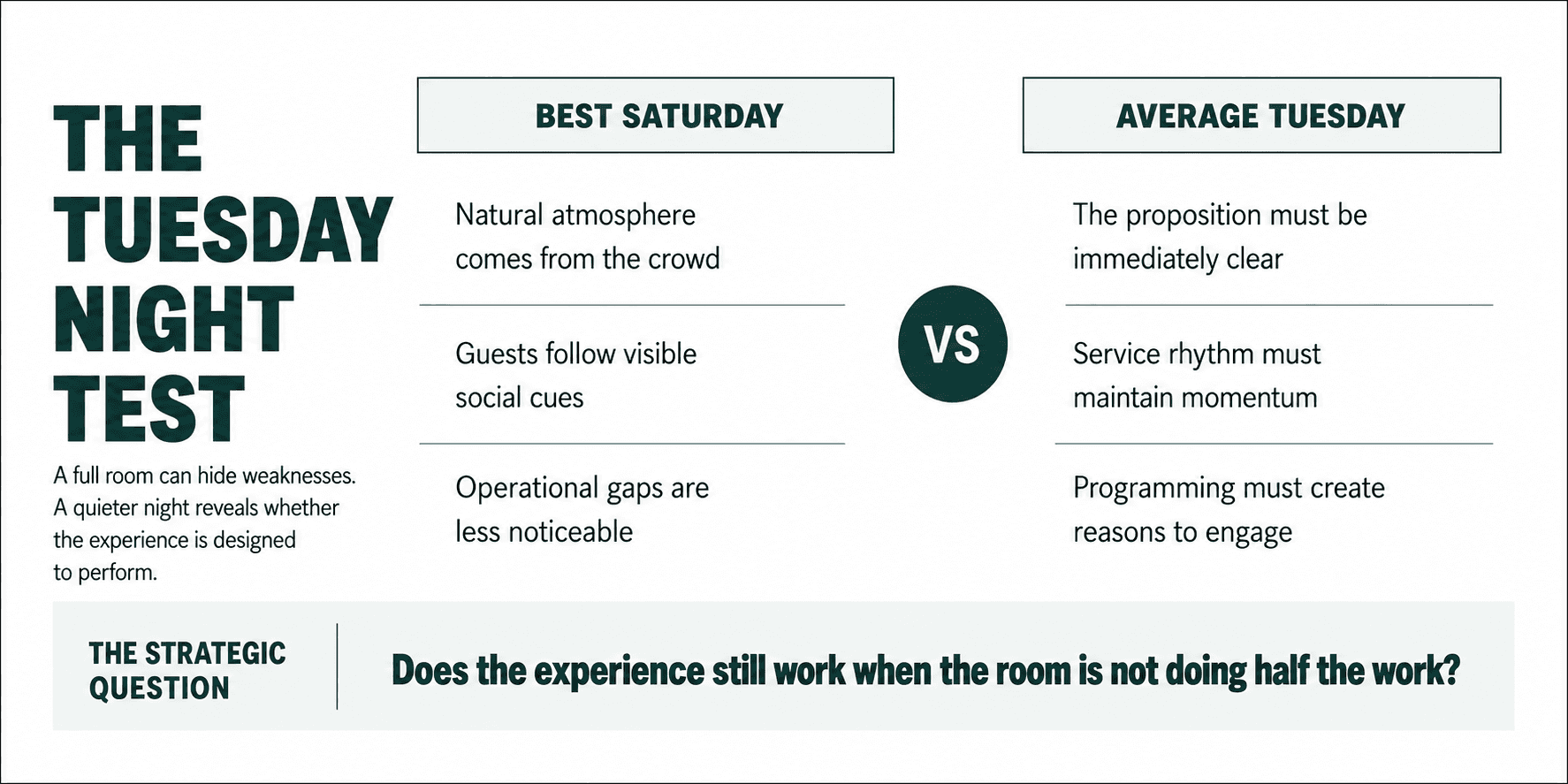
When the crowd arrives ready, the energy is already in the room. People have made an occasion of it. The venue can feel successful because demand is doing half the work. The operator still has plenty to get right, but the atmosphere arrives with the guests.
Tuesday nights are different. There is no launch-night novelty, no full room to disguise an awkward journey and no automatic sense of occasion. The venue has to give the people who are there a clear reason to choose it, understand it and join in.
Experience-led hospitality is the deliberate design of the whole guest relationship, from expectation and arrival to participation, service, memory and return. It aligns brand promise, customer journey, service and environment around how people actually behave. [2]
Guest experience is what people encounter across that relationship: what they understand, how easily they can take part, how service makes them feel, how other guests shape the atmosphere and what remains in memory afterwards. [1]
The purpose is not simply to make a place look distinctive. It is to create clearer reasons for people to gather, participate, stay, spend, remember and return. That is the argument behind The Experience-Led Hospitality Playbook.
Why This Playbook Exists
The Experience-Led Hospitality Playbook is about the shift from venue as offer to venue as relationship.
Restaurants sell food. Bars sell drinks. Hotels sell rooms. Cinemas sell films. Retail sells goods. Leisure venues sell activities. Those distinctions may still make sense operationally. They make less sense from the guest’s point of view.
People do not experience departments. They experience a sequence of expectations, decisions, signals, interactions and memories. They arrive with a mood, a group dynamic, a reason to be there and a tolerance level for friction.
Brand experience is what connects those moments. It aligns the promise people saw before they arrived with the way the venue behaves when they are inside it, and with the memory they carry afterwards.
The purpose is not simply to make a place look distinctive. It is to create clearer reasons for people to gather, participate, stay, spend, remember and return.
What Tuesday Nights Reveal About Guest Experience
Most venues are judged through their best moments: weekends, celebrations, launch events and full rooms. These are also the moments that tend to shape briefs, renders, photography and case studies.
Quieter nights expose a different truth. The brand that felt exciting in month one can start to feel like a setting rather than a destination. An activity can be entertaining but socially awkward. A customer journey that seemed obvious on Friday can become uncertain when fewer people are carrying the rhythm. Service can be friendly and still leave guests unsure about what happens next.
Atmosphere is not a finish, a playlist or a lighting level. It is the result of many signals working together: whether people understand the offer, how easily they can move between participation and conversation, whether the service pace suits the occasion and whether the venue still feels intentional at half capacity.
A strong brand does not manufacture a crowd. It gives the people who are there a clear way to belong.
What Is Experience-Led Hospitality?
Hospitality and leisure have traditionally been organised around products. Restaurants sell food. Bars sell drinks. Hotels sell rooms. Cinemas sell films. Retail sells goods. Leisure venues sell activities.
Those distinctions may still make sense operationally. They make less sense from the guest's point of view. People do not experience departments. They experience one evening.
They move between arriving, waiting, watching, playing, eating, drinking, talking and deciding what to do next. The activity may be the reason they booked, but it is not necessarily the part they remember most clearly. A conversation, a service gesture, a shared joke or the way the group felt together may carry more weight than the central offer.
Calling hospitality experiential is not the insight. Hospitality has always been experienced. The strategic shift is from thinking in separate products and touchpoints to designing one connected system of behaviours, decisions and memories.
Competitive socialising is one of the clearest places to see the shift. It gives people something to do together, a framework for interaction and permission to participate without having to manufacture the social energy themselves.
The Brand System Underneath
The strongest venues connect the reason people choose them with the arrival, the activity, the service rhythm, the social atmosphere and the memory afterwards.
No single element can carry that system. A distinctive identity cannot rescue an unclear journey. A beautiful room cannot create participation on its own. A brilliant game cannot compensate for waiting that feels like neglect. Friendly service cannot hold together a promise that changes from channel to channel.
When the system is coherent, people understand the offer faster, join in more easily, stay without being managed and leave with a clearer story to tell. That is where brand experience becomes commercially useful. [3]
Return is not built at the end of the visit. It is accumulated throughout it.
Why Competitive Socialising Matters Beyond the Game
Competitive socialising is a strong proof point for the Playbook, but it is not the full container. It shows how a clear activity can organise participation, service, social energy and memory. The same human questions apply to hotels, restaurants, cinemas, food halls, retail destinations, mixed-use developments, cultural venues and other brand-led physical experiences.
What gives people a reason to leave home? What helps them understand how to take part? What makes the experience easy to share with others? What turns time spent into a memory? What makes a second visit feel desirable rather than merely possible?
The formats change. The human questions do not.
01
Brand promise shapes expectation.
02
Guest journey shapes participation.
03
Service shapes feeling.
04
Environment shapes behaviour.
05
Memory shapes return.

The Eleven Chapters
1
What Is Competitive Socialising?
Why people are not only buying games. They are buying permission to participate.
2
The Power of Play
How play lowers social friction and gives the brand experience a behaviour people can join.
3
The Digital Playground
Why technology should reduce friction, create feedback and extend the relationship beyond the visit.
4
Hybrid Havens
How physical and digital layers work only when brand promise, journey, service and social behaviour align.
5
Culinary Synergy
Why food and drink create ritual, memory, dwell time and reasons to return.
6
Cinemas Reimagined
Why cinema must become a fuller social brand experience, not only content delivery in a dark room.
7
Retail Meets Play
How retail moves from transaction towards participation, memory and cultural relevance.
8
Broadening Horizons
Why stronger experiences are designed for the whole group, not only the active participant.
9
Smart Scale
How brand behaviour, service standards, journey principles and experience logic can travel.
10
The Magnetic Middle
Why aspiration must feel special, but accessible enough to reach a wider audience.
11
The Flagship Effect
How a flagship becomes a brand belief system made physical, memorable and shareable.
Takeaway
Review your venue on an average Tuesday, not only on its best Saturday. The strongest experiences create clarity, energy and reasons to participate even when the room is not full.
What Comes Next
The Playbook begins with competitive socialising because it makes this wider shift unusually clear. Chapter 01 asks the first question: what is it, really?
Not simply darts, golf, bowling, karaoke or shuffleboard with better drinks. Not a game placed inside a bar and promoted as an experience. People are not only buying access to an activity. They are buying permission to participate.
Competitive socialising shows what happens when play gives a group a shared script, food and drink support the rhythm, service makes participation easier and the brand turns the evening into something people can remember and repeat. That is where the series begins.