THE EXPERIENCE-LED HOSPITALITY PLAYBOOK
Article 03
The Digital Playground
Technology place when it gives an interaction greater clarity, consequence and continuity. The strongest digital layers do not compete with the human experience. They help the experience respond.
By Ales Kernjak, AK Works · 11 min read
Co-authored with Zachary Pulman, Zachary Pulman Design Studio
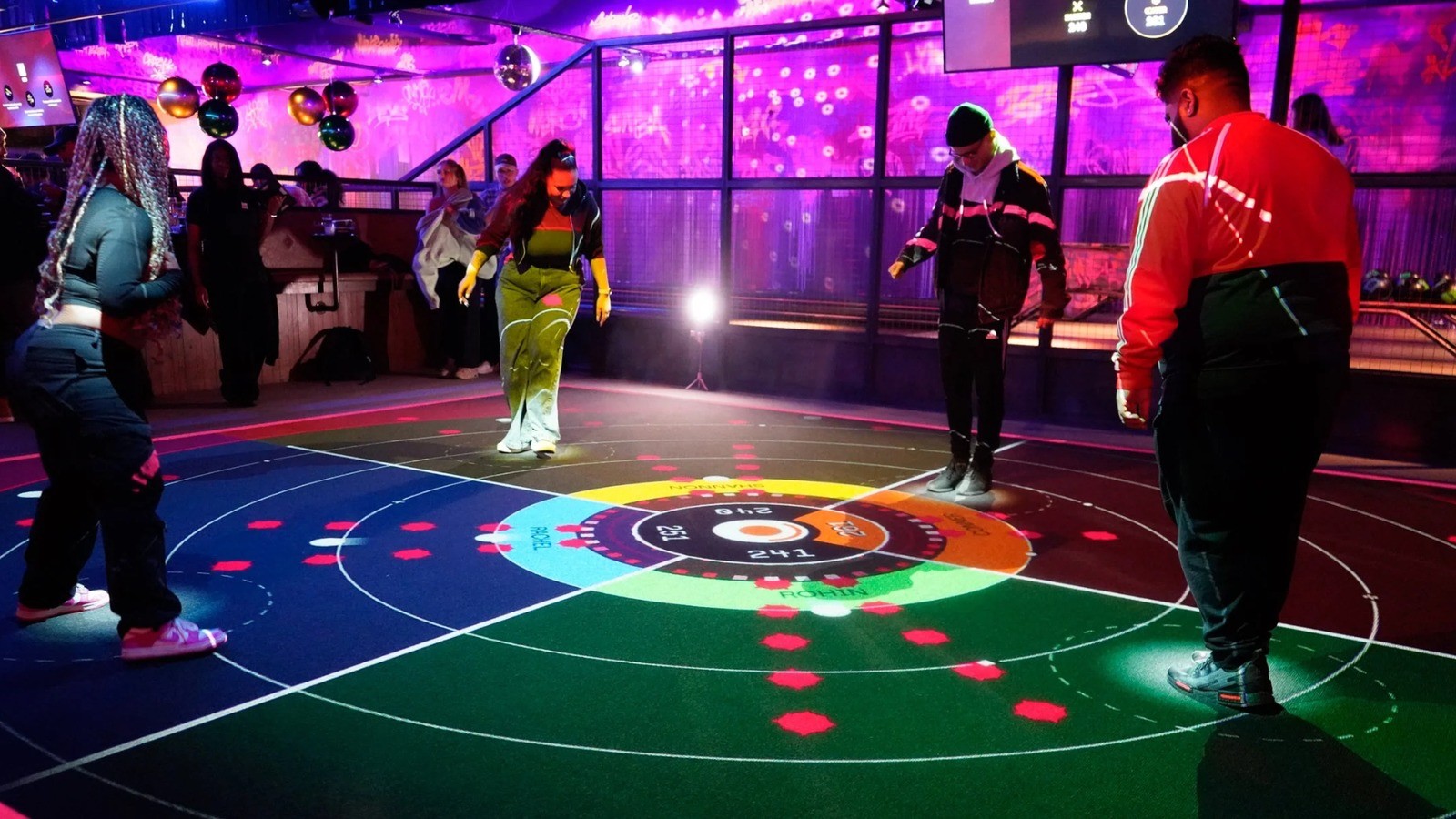
Digital play becomes most powerful when the technology responds to the group and turns physical action into a shared moment. Photo credit: Moment Factory / Lane7 https://momentfactory.com/products/augmented-games-at-lane7
When the Environment Starts Responding
A ball is struck. A dart lands. A putt disappears into the hole.
Then something happens.
The score changes. The wall reacts. A player’s name moves up the ranking. The next challenge appears. Everyone understands immediately that the moment mattered.
This is where digital begins to change play.
Physical activity already gives people something to act on. Technology can add another layer: it can interpret the action, respond to it, record it and carry its meaning forward.
The opportunity is not to surround guests with more screens, sensors or spectacle. It is to make the interaction clearer, faster and more consequential without asking the guest to manage the complexity behind it.
The most effective digital systems disappear into the experience. They calculate without asking. They remember without interrupting. They make progress visible. They help the room understand what just happened and what happens next.
Technology Has to Earn Its Place
Hospitality and leisure have never suffered from a shortage of things that look impressive in a presentation.
Projection mapping. Motion tracking. Reactive lighting. Augmented environments. Connected apps. Digital scoreboards. Personalised profiles.
The question is not whether any of them are technically interesting. The question is what they change for the guest.
Does the system make the activity easier to understand? Does it reduce unnecessary administration? Does it give the action greater meaning? Does it improve the pace of the experience? Does it make a first visit easier and a second visit more interesting?
If the answer is no, the technology is decoration.
A venue can be technically sophisticated and behaviourally clumsy. Guests can still arrive confused, wait too long, miss what is happening, struggle with an interface or spend half the evening helping one another operate the thing that was supposed to make everything easier.
Digital does not automatically remove friction. Sometimes it simply gives friction a touchscreen.
Complexity Should Disappear Behind the Experience
One of technology’s most useful roles is also one of its least glamorous: taking complexity away from the guest.
Scoring is an obvious example. Puttshack’s Trackaball system tracks the ball and manages scoring automatically. Flight Club uses automated scoring and digital game formats to reinterpret darts for broader social audiences [4][5].
The visible technology is only part of the point. The more important shift is that the guest no longer has to administer the game.
Nobody needs to become the group’s accountant. Nobody needs to stop the conversation to check whether a score was entered correctly. Nobody needs prior knowledge before the first round can begin.
Digital systems can hold the rules in the background while allowing the interaction to stay in the foreground.
That principle extends beyond gameplay. Booking can remember the group. Onboarding can explain the first move. Interfaces can guide without requiring lengthy instruction. Payment can move through the experience without repeatedly stopping it.
The sophistication belongs behind the scenes. The guest should experience simplicity.
Feedback Changes the Meaning of the Moment
A digital score does more than save someone from arithmetic. It gives an action context.
A physical result tells the player what happened. Digital feedback can tell the entire group what it means.
A score moves. A personal best appears. A team takes the lead. A projected animation makes a near miss feel surprisingly important. A challenge changes. Someone who was not watching suddenly knows there is something worth reacting to.
This is where digital feedback becomes part of the social choreography of the room.
The technology does not create the reaction. It makes the consequence easier to understand. A screen filled with animation is not inherently immersive. Neither is a wall that flashes every time somebody touches something. Response needs hierarchy.
The environment should know which moments deserve amplification and which ones should simply pass. Otherwise everything becomes significant and, rather quickly, nothing is.
The strongest systems frame the moment rather than overwhelm it.
Research into gamification in tourism and hospitality supports the underlying logic, but with an important caveat. A systematic review found that game mechanics can influence engagement through behavioural and psychological outcomes, while empirical hospitality research shows that gamified digital interactions can affect enjoyment, perceived value and subsequent behaviour. The effect depends on how the mechanics are designed, not simply on their presence [1][3].

Technology becomes valuable when it helps the action mean more, keeps the experience moving and gives the guest a reason to return.
Momentum Is Designed Between the Turns
The obvious part of digital play happens during the action. The more interesting part often happens between actions.
Who goes next? How long does the group wait? Can people order while someone else is playing? Does the score update quickly enough to sustain the energy? Can a late arrival understand what is happening?
What happens while a system resets? Can someone leave the activity briefly and rejoin without derailing the group?
These are experience-design questions, not software questions.
Technology can improve the rhythm of an occasion, but only when it has been designed around how people actually behave.
The fastest system is not necessarily the best system. Sometimes anticipation is useful. Sometimes a reveal deserves a pause. Sometimes the technology needs to step back so that conversation, food, drink or celebration can take over.
Good digital experience design therefore requires restraint. The objective is not constant stimulation. It is momentum.
Good digital experience design therefore requires restraint. The objective is not constant stimulation. It is momentum.

Live scoring gives physical play immediate context, making the result visible to the player and the group. Photo credit: Flight Club Atlanta https://www.flightclubdartsusa.com/atlanta
The Guest Experiences One Journey
Operators may see separate platforms for booking, CRM, scoring, food ordering, payment, loyalty and marketing. Guests do not. They experience one evening.
That makes integration a brand-experience issue rather than simply a technology issue.
If the booking knows who you are but the venue does not, the experience breaks. If a player profile records your score but cannot recognise you on the next visit, the relationship stops. If food ordering interrupts play rather than moving with it, digital convenience has simply created a different inconvenience.
And if every touchpoint speaks a different language, asks for different information or behaves according to different logic, the brand starts to feel like several businesses sharing a building.
The stronger approach is to design the digital journey around continuity.
Discovery should lead naturally to booking. Booking should prepare arrival. Arrival should lead easily into play. Play should connect to service. The session should create something worth carrying into the next visit.
Technology is most valuable when the individual tools stop feeling like individual tools.
Progress Changes the Reason to Return
A traditional loyalty programme rewards transactions. Digital play can reward progress.
That is a much more interesting relationship.
A score can become a personal benchmark. A challenge can remain unfinished. A ranking can be defended. A team can continue. A player can return not simply because they enjoyed the venue, but because something has moved forward since the last visit.
That distinction matters because progression is not the same as points for their own sake. Hospitality research into gamified platforms suggests that feelings such as mastery, purpose and relatedness can be more meaningful drivers of ongoing motivation than superficial rewards alone [2].
Topgolf’s Toptracer technology makes performance measurable through ball tracking and different game formats. The important principle is not the golf technology itself. It is that an activity can acquire history [6].
Once the system remembers, the next session no longer needs to begin from zero.
The first visit is an occasion. The next can become progression. Over time, progression can become identity.
And identity is where digital play becomes much more interesting.
What Happens When the Score Leaves the Venue?
Most hospitality experiences still end geographically. You leave the building and, operationally at least, the experience is finished.
Digital systems can change that boundary.
A score can exist after the session. A player profile can remain active. A ranking can change. A team can continue. A challenge can wait. A future booking can carry the history of previous visits with it.
The experience begins to develop an afterlife.
The next evolution could go further: one player identity that works across several locations; scores, achievements and rankings that travel with the person; players discovering opponents at a similar level; teams joining wider competitions; or people arranging games with someone in another city or country.
Cross-location competition is already visible in systems such as Toptracer, where logged-in players can participate in global challenges across participating venues [7].
The venue is no longer the entire experience. It becomes one point within a larger participation network.
That raises an important strategic question for operators: does the digital relationship belong to the venue, or increasingly to the player?
Most loyalty systems are designed around ownership. The brand owns the database. The operator owns the programme. The customer joins. A connected-play model could move closer to a different relationship, where the player carries their history, identity, connections and status with them.
For hospitality, that is a significant shift. The commercial competition may no longer be only for the next booking. It may be for a meaningful place inside the player’s wider social ecosystem.

Digital scoring becomes more powerful when it evolves into player identity, progression and connected participation across visits, venues and locations.
From Customer Profile to Player Identity
There is a subtle but important difference between knowing a customer’s name and recognising who they are within the experience.
A CRM profile can tell an operator that someone visited three times. A player identity could know considerably more about the role they actually play: what they prefer, what they have achieved, who they play with, how competitive they are and what they are trying to improve.
Used intelligently, this could make personalisation much more useful. The system does not merely say,
“Welcome back.” It understands where the experience should continue.
There is a line, of course. Recognition can quickly become surveillance if the benefit to the guest is unclear.
More data does not automatically create a more personal experience. Often it simply creates more data.
The test should remain simple: does remembering this information make the next interaction genuinely better? If not, the brand probably does not need to know it.
AI Could Make the System More Responsive
Artificial intelligence will inevitably enter this environment, but its useful role is unlikely to be replacing the social experience.
Its stronger potential is in making the systems around that experience more responsive.
Some of that shift is already visible in adjacent technology. Toptracer introduced AI-assisted shot tracing in 2026 to improve the speed, scale and accuracy of ball tracking. That does not prove the wider AI applications described here, but it shows how machine intelligence is beginning to move into the operating layer of live play [8].
An AI-supported platform could adjust difficulty according to ability, suggest opponents with compatible skill levels, generate challenges based on previous performance, identify which game format is likely to work for a particular group or provide coaching without turning a casual evening into a training session.
It might eventually allow people to practise against digital opponents modelled around playing styles, or connect physical venues through more intelligent matchmaking.
For operators, AI could also help interpret behavioural patterns across bookings, play, service and return visits.
But the same rule applies as everywhere else in the digital playground: intelligence behind the scenes should create simplicity in front of the guest.
If the AI requires more management than the game, we have probably taken a wrong turn.
The strongest use of AI may ultimately be the least visible one. The guest does not need to marvel at the intelligence of the system. They need to feel that the experience understands what should happen next.
Digital Behaviour Is Local
Technology can travel quickly. Guest behaviour does not.
Payment habits, platform preferences, privacy expectations, family structures, service conventions and attitudes towards competition vary significantly between markets.
A seamless digital journey in one country may feel completely unnatural in another.
In parts of Asia, the expectation may be that messaging, payment, booking and loyalty sit within platforms guests already use every day. In Europe, operators may find greater value in digital layers that quietly enhance familiar activities. In North America, scale, visible competition and integrated entertainment systems may play a larger role. Across the Middle East, investment in entertainment is creating increasingly connected destinations combining hospitality, retail, leisure and technology [4][9].
This is not primarily a localisation problem. It is a behaviour problem.
Changing a language setting is easy. Understanding how people organise an evening, divide a bill, form a group, book an activity, express status or expect to be recognised is considerably harder.
Digital experience therefore needs the same cultural intelligence as service, space and brand.
A technically consistent global system can still create an inconsistent guest experience.
When the System Stops, the Experience Cannot
There is another reason the human layer remains essential. Technology fails.
Sensors misread. Screens freeze. Connections disappear. Accounts refuse to recognise the person standing directly in front of them.
A digitally enabled concept therefore requires more than a technology stack. It requires a service model capable of recovering the experience when that stack misbehaves.
Staff need to know when to intervene and when to step back. They need to understand the game well enough to preserve momentum while fixing the system. They need language that reassures without turning a technical problem into the defining memory of the evening. And they need permission to solve problems quickly.
Service recovery is not separate from digital experience design. It is part of it.
The more dependent the concept becomes on technology, the more important the human operating layer becomes.
The screen may go dark. The hospitality cannot.
The Best Digital Layer Leaves the Human Moment Intact
The future of competitive socialising is unlikely to be a choice between physical and digital. That distinction is becoming less useful.
The more important question is what the technology contributes.
Does it clarify? Does it respond? Does it keep momentum? Does it create progress? Does it connect one visit to another? Can it extend a player’s relationship beyond one venue without taking attention away from the people standing beside them?
That is the real digital playground.
Not a room filled with technology. A system in which physical action can acquire feedback, history, identity and connection.
For operators, the opportunity goes beyond novelty. Connected digital layers can create adaptable games, richer behavioural insight, new programming possibilities and stronger reasons to return.
For guests, the benefit should feel much simpler.
They act. The experience responds. Something moves forward.
And perhaps, long after they have left the venue, the game is still going.
Takeaway
Digital technology becomes valuable when it gives play greater consequence and continuity. Automatic scoring can remove administration. Responsive environments can make results easier to understand. Connected systems can protect momentum across booking, play, service and payment. Profiles and progression can give a second visit a different meaning from the first. The next opportunity goes further. When scores, achievements, teams and player identities persist beyond a single session, the relationship no longer has to end at the venue door. Connected play can begin to turn individual locations into parts of a wider participation ecosystem. AI may make those systems more responsive still, but the principle remains unchanged: the technology should become more sophisticated so that the guest experience can become less complicated. The player should notice the moment. Not the machinery behind it.
What Comes Next
Article 04, Hybrid Havens. Once digital can respond to behaviour, remember the player and connect the journey, the next challenge is physical. How do space, technology, service and programming work together when a venue needs to change by audience, occasion and time of day? It explores the physical and digital crossover, and what happens when the venue itself becomes an adaptable experience platform.